
October 26, 2026
Energy Prices Are Rising in Northern Virginia. Here's What You Can Still Control.
James Symanski, PE, MBA, LEED AP, CEM
Fall walk-throughs tend to start with the same question. The owner hands us a stack of bills and asks why they keep going up when nothing in the house or the building has changed. The answer has two parts. The price of each kilowatt-hour has gone up, nationally and here in Virginia, and the official forecasts say it isn't finished. But how many kilowatt-hours you buy is still mostly up to you, and that's the part we can work on.
What has happened nationally
The average U.S. home paid 13.15 cents per kilowatt-hour for electricity in 2020 and 17.23 cents in 2025, about 31 percent more, according to the U.S. Energy Information Administration. Commercial customers saw about 26 percent over the same years, from 10.59 to 13.37 cents. EIA's October Short-Term Energy Outlook forecasts the residential average at about 18.2 cents in 2026 and 18.7 cents in 2027.
What is happening in Virginia
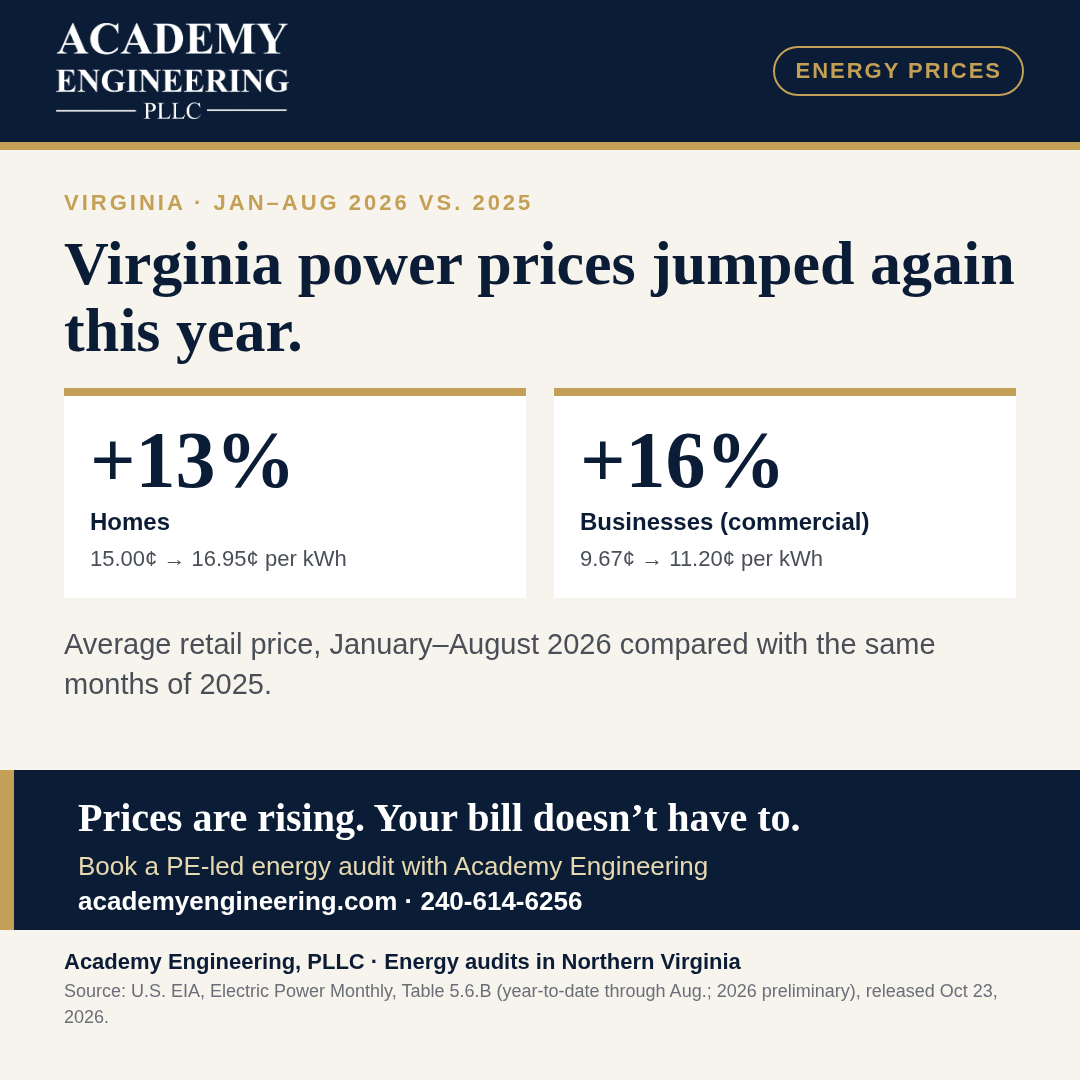
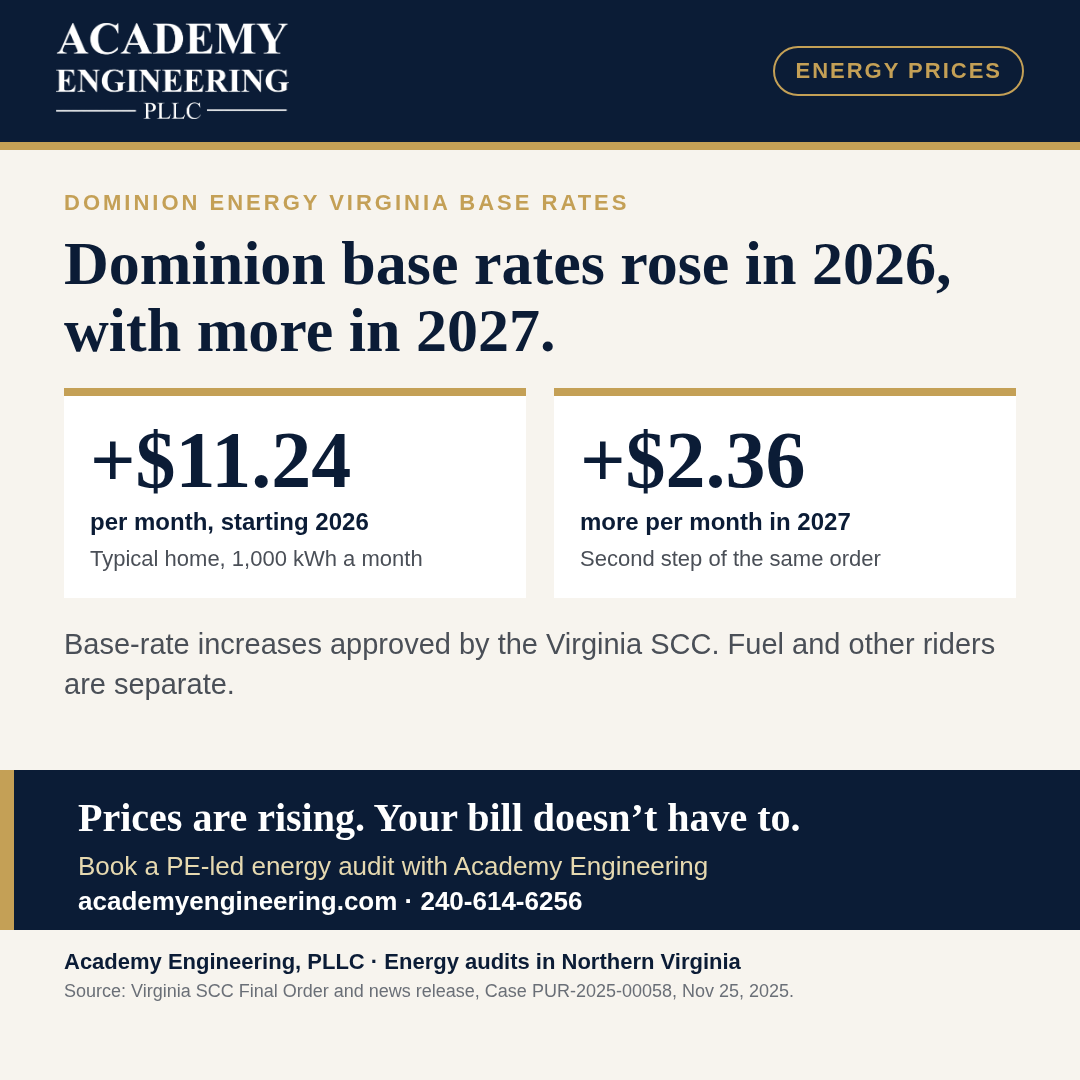
Virginia is rising faster than the country this year. For January through August 2026, EIA preliminary data puts the average Virginia residential price at 16.95 cents per kilowatt-hour, against 15.00 cents for the same months of 2025. That is about 13 percent. Commercial prices went from 9.67 to 11.20 cents, about 16 percent. Part of that is base rates. In November 2025, the State Corporation Commission approved Dominion Energy Virginia base-rate increases of $11.24 a month for a typical residential customer in 2026 and another $2.36 a month in 2027 (Case PUR-2025-00058). Fuel and other riders are billed on top of base rates.
One more charge is proposed, and it has not been decided
Dominion has asked the SCC to reinstate a Rider RGGI to recover the cost of carbon allowances now that Virginia is rejoining the Regional Greenhouse Gas Initiative. As filed, it would add about $13.00 a month for a typical home using 1,000 kilowatt-hours, starting March 1, 2027. Dominion also offered a mitigation option with a smaller monthly impact. The SCC hearing is scheduled for October 28, 2026 (Case PUR-2026-00085). This is a request, not an approved rate, and the final number could be lower or could be different.
Why prices are moving
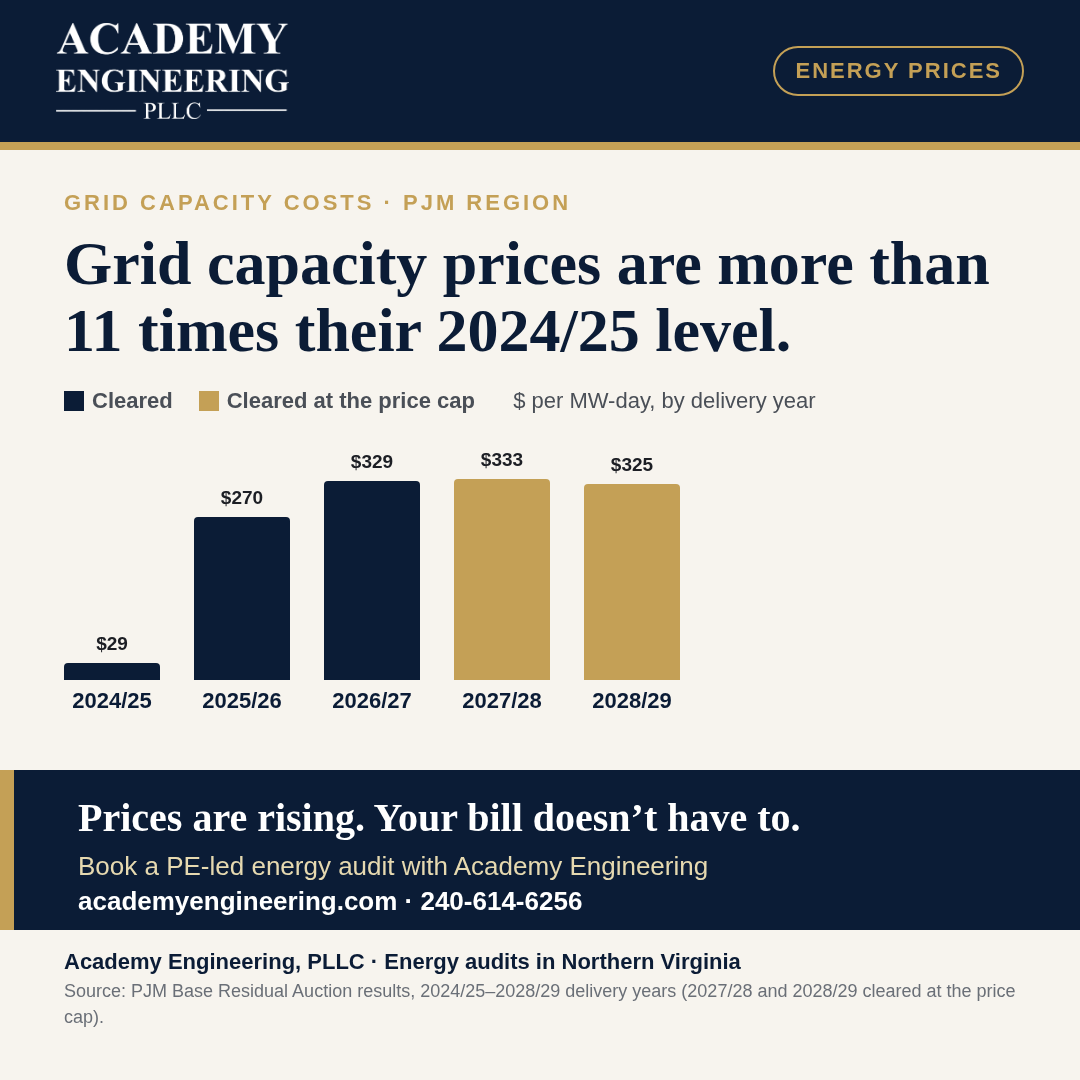
Demand on the regional grid is growing faster than new supply, much of it from very large users. Here in Northern Virginia that means data centers, and the SCC has created a new rate class for customers demanding 25 megawatts or more that takes effect in 2027. PJM, the grid operator that serves Virginia, buys power plant capacity years in advance, and its capacity auction cleared at $28.92 per megawatt-day for 2024/25, $269.92 for 2025/26, $329.17 for 2026/27, and the $333.44 cap for 2027/28. That is more than eleven times the 2024/25 price, and capacity costs flow into the supply portion of electric bills. EIA expects PJM wholesale power prices to average 41 percent more in 2026 than in 2025, the largest increase of any region, before easing about 7 percent in 2027 if winter weather returns to normal. Fuel matters too. For this winter, EIA expects homes that heat with electricity to spend about 4 percent more, heating oil homes about 21 percent more, and natural gas and propane homes somewhat less.
What homeowners can do this winter
Start with the envelope. EPA estimates homeowners save an average of 15 percent on heating and cooling costs by sealing air leaks and adding insulation in attics, crawl spaces, and basement rim joists. Ducts are next. In a typical house, 20 to 30 percent of the air moving through the ducts is lost to leaks and poor connections, and ducts in attics and crawl spaces are the usual problem. Then the controls. DOE's Energy Saver Guide says turning the thermostat back 7 to 10 degrees for 8 hours a day can save up to 10 percent a year on heating and cooling. If you have a heat pump, use a thermostat designed for one, because a big manual setback on a cold night can bring on the backup electric heat, which costs more. Set the water heater to 120 degrees, since water heating is about 18 percent of a typical home's energy use. And check the furnace or heat pump filter every month.

A note on tax credits
The federal 25C Energy Efficient Home Improvement Credit is not allowed for property placed in service after December 31, 2025, according to the IRS. If you made qualifying upgrades or paid for a home energy audit in 2025, ask your tax preparer about your 2025 return. Going forward, the savings have to come from the bill itself.
What businesses can do
ENERGY STAR estimates that on average, 30 percent of the energy used in commercial buildings is wasted. In the buildings we walk, the cheapest fixes are almost always schedules and controls. Set back heating and cooling when the building is empty, turn on sleep settings for office equipment, and walk the building after hours to find what shouldn't be running. Watch demand charges. Under Dominion's published Schedule GS-2 for non-residential customers, billed demand is the highest average kilowatt draw in any 30-minute interval of the month, so one half-hour with everything starting at once can set the demand charge for the whole month. Stagger equipment start-ups. Keep up with rooftop units before each season: filters, coils, belts, refrigerant, and economizer dampers. On lighting, ENERGY STAR says occupancy sensors can save 15 to 30 percent of lighting costs, and LEDs use up to 90 percent less energy than incandescent lamps.

Use the programs that already exist
Dominion's Small Business Improvement Enhanced Program offers qualifying Virginia customers an on-site assessment and incentives for measures such as LEDs and sensors, HVAC tune-ups, duct sealing, controls, and refrigeration upgrades. Check the program page for current terms. Benchmark the building in ENERGY STAR Portfolio Manager, which is free. In an EPA analysis of more than 35,000 buildings, those that benchmarked consistently cut energy use by an average of 2.4 percent a year, 7 percent over three years. And ENERGY STAR certified buildings use 35 percent less energy than similar buildings, according to EPA.
How Academy Engineering helps
Every engagement is led by a professional engineer licensed in Virginia and Missouri who is also a CEM, CEA and LEED AP. For commercial buildings and facilities, we perform on-site energy walk-throughs at $200 per hour including the report, with published bands from $800 to $1,200 for small buildings up to $2,500 to $4,000 for large or multi-building properties. Across Virginia, a desktop energy audit built from twelve months of bills, usage data, and photos looks for better rate structures, rebates, and renewable and storage options without a site visit. And for owners pursuing certification, we provide the Professional Engineer verification review that ENERGY STAR requires.
The engineer behind the work
Academy Engineering is led by James Symanski, PE, CEM, CEA, LEED AP, a professional engineer licensed in Virginia and Missouri. He has been helping large organizations and homeowners reduce their energy bills since 2009. His experience includes developing the energy conservation policy for the U.S. Army's Presidio of Monterey, and co-authoring Save Your Energy: Home Energy-Saving Solutions. Every assessment we deliver is performed or reviewed by a licensed professional engineer, and recommendations are prioritized by cost and expected savings so clients know where to invest first.
Beyond energy, the firm provides flood risk and FEMA flood map reviews, code compliance reviews, light civil design, permitting support, and facility condition assessments. We serve clients on site throughout Northern Virginia and remotely across Virginia.
You can't set the rate, but you can cut the kilowatt-hours
If your bills have gone up and you want to know where the money is going, request a commercial walk-through or desktop audit or call 240-614-6256. Tell us the town, the number of buildings, and the square footage of each, and we will confirm scope before we start.